
Most Juwa 777 fish table players lose coins the same way.
They open the game, start firing immediately at maximum multiplier, chase targets leaving the screen, and burn through their balance before the session ever finds its rhythm.
The players who consistently walk away with more coins than they started with do not play differently because they are luckier.
They play differently because they make better decisions — at the start of the session, during the session, and at the end of it.
These seven tips cover every one of those decisions.
If you already know the basics of how fish table games work — our complete fish table mechanics guide covers that in full — this post is what comes next.
Know How to Play Juwa Fish Table Games
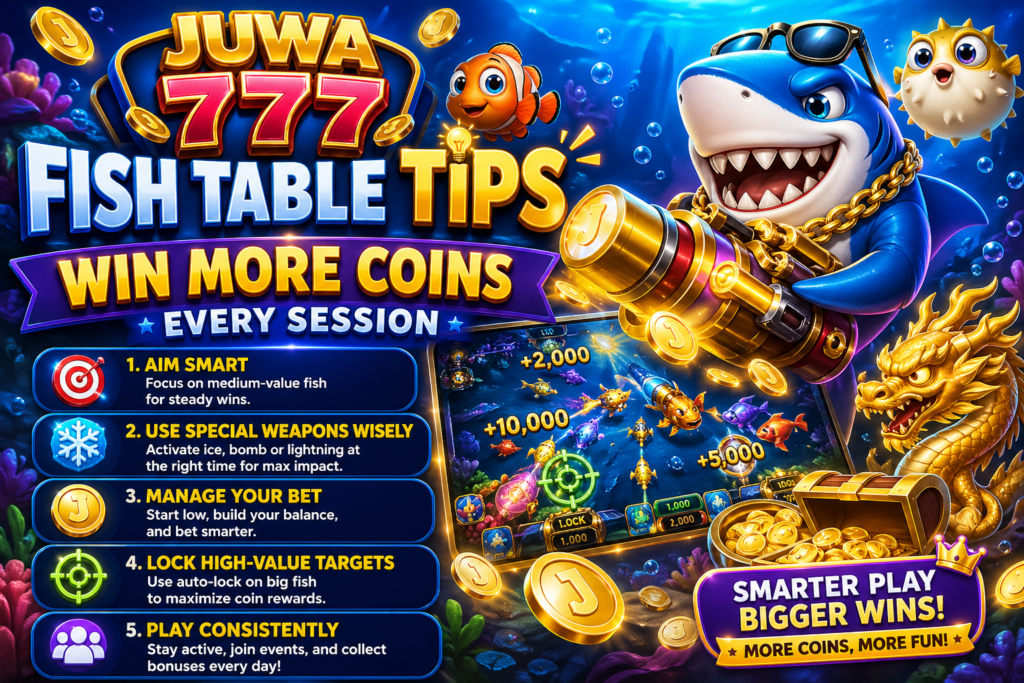
Quick Takeaway
- Set a session coin budget before opening the game — players with a defined limit consistently outperform players who play until they run out
- Start every session on your lowest viable multiplier — the first 60 seconds are for reading the screen, not spending coins
- Read the screen for 15 seconds before firing — target identification before the first shot changes everything
- Bonus targets deliver the best coin return on the screen — when one appears, everything else is secondary
- Never chase a departing target — this single habit saves more coins per session than almost any other change you can make
- Protect a winning session with a stop-win rule — decide your exit point before you start, not during the session
Know How to Get Free Coins on Juwa 777 Every Day
Why Most Fish Table Sessions Go Wrong?
The honest answer is that most fish table sessions go wrong before the first shot is fired.
Players open the game with no plan — no budget, no multiplier strategy, no target priority system.
They react to whatever is on the screen rather than making deliberate decisions based on a framework they brought into the session.
Reactive play is expensive play.
Every one of these seven tips exists to replace a reactive habit with a deliberate decision. Apply all seven consistently and your session outcomes become measurably more predictable over time.
Know About Juwa 777 Bonus Guide
Tip 1 — Set Your Session Budget Before You Open the Game
This is the single highest-impact habit change available to any fish table player — and it costs nothing to implement.
Why It Matters:
Players who define their session coin limit before opening the game make fundamentally different decisions during the session than players who have no limit in mind.
When you have a defined budget, every shot is evaluated against how much of that budget it costs. When you have no budget, every shot feels like it comes from an unlimited pool — until it does not.
The discipline of a pre-set budget is what separates players who end sessions in profit from players who always seem to lose a bit more than they intended.
How to Apply It:
Before opening any fish table game on JuwaQuest, decide the maximum number of coins you are willing to spend in this session. Not a rough estimate. A specific number.
Once you hit that number — the session ends. Not after one more wave. Not after the bonus target that just appeared. When you hit your number, you stop.
The session budget is not a suggestion. It is a rule you set for yourself before emotion is involved. Stick to it every time.
Pro Tip: Set your session budget at a level where losing the full amount does not change how you feel about playing tomorrow. Sessions that do not threaten your overall coin health keep the experience genuinely enjoyable over the long term.
Tip 2 — Start Every Session on the Lowest Viable Multiplier
The opening 60 seconds of every fish table session are not for earning coins. They are for gathering information.
Why It Matters
The screen at the start of a session is unpredictable. You do not know yet which high-value targets are active, how fast the fish are moving, whether a bonus target is about to appear, or how productive this particular screen configuration is going to be.
Spending coins at high multipliers before you have that information is the second most expensive mistake in fish table gaming.
How to Apply It
Open the game and immediately set your multiplier to its lowest viable setting — typically between 1 and 3, depending on your balance.
Play the first 60 seconds at that setting. Watch what targets appear. Note which high-value fish are active. Identify the movement patterns. Locate any bonus targets.
Once you have read the screen properly, then make your multiplier decision based on what you have actually seen rather than what you hope to find.
Reminder: A low multiplier opening costs you almost nothing in terms of missed opportunity. The fish that appear in the first 60 seconds will have wave equivalents throughout the entire session. You are not missing them — you are learning about them before committing real coin volume to targeting them.
Tip 3 — Read the Screen for 15 Seconds Before Firing
This is the most underused habit in fish table gaming and one of the most valuable.
What to Look For:
Spend 15 seconds at the start of every session — and after every major screen transition — doing nothing except observing.
Identify which high-value targets are currently active. Not all high-value fish appear on every screen. Some sessions load with premium targets. Some load with primarily low-value fish. Knowing this before you fire changes your entire multiplier and targeting approach.
Locate any bonus targets. Bonus targets sometimes appear within the first few seconds of a screen. Players who fire immediately without looking often miss them entirely or waste opening shots on standard fish while a bonus target is available.
Note the movement direction and speed. Fish moving toward the center of the screen are easier to hit than fish moving toward the edges. Fast-moving targets cost more shots per kill than slow-moving ones. Knowing this before you fire improves your shot efficiency from the first hit.
How to Apply It:
15 seconds. Every screen transition. No shots until the read is complete.
This habit feels unnatural at first because the instinct is to start firing immediately. Override that instinct. The 15 second investment consistently delivers better shot selection than any amount of rapid reactive firing.
Pro Tip: Combine this tip with Tip 2. Low multiplier plus 15 second screen read at the start of every session is the single most effective two-habit combination in fish table gaming.
Tip 4 — Prioritize Bonus Targets Above Everything Else
When a bonus target appears on the screen, everything else becomes irrelevant until it is gone.
Why Bonus Targets Are Different:
Standard fish have a straightforward coin value. You shoot them, they die, you collect the coins. The return is predictable and proportional.
Bonus targets break that proportionality completely. Their coin return relative to their difficulty is consistently the best deal on the screen — often by a factor of 3 to 5 compared to the next best standard target at the same cost per shot.
This is not a marginal difference. It is significant enough that missing a bonus target while spending coins on standard fish represents a real lost opportunity every single time it happens.
How to Apply It:
The moment a bonus target appears — increase your multiplier to match the target value and redirect all shots to that target immediately.
Stop shooting whatever you were shooting. Do not finish a fish you were already working on if the bonus target is available. The bonus target takes full priority.
When the bonus target is gone — killed or departed — drop back to your base multiplier and return to your standard targeting approach.
Note: Bonus targets appear on a timer in most Juwa fish table games. If you miss one, another will appear. Do not panic-fire at a departing bonus target. Burning 20 shots at a target that is leaving the screen is more expensive than the missed opportunity of letting it go.
Tip 5 — Adjust Your Multiplier Based on Screen Density
Your multiplier should never be static throughout a session. It should respond directly to what is happening on the screen in real time.
High-Density Screens:
A high-density screen is one where multiple high-value targets are active simultaneously — premium fish, bonus targets, or large fish schools with strong coin return.
On a high-density screen — increase your multiplier. More high-value targets on screen means more opportunities to land profitable shots. Higher multipliers amplify the return on every successful hit when the screen is loaded with opportunities.
Low-Density Screens:
A low-density screen is one where most active targets are low-value fish with poor coin return at any multiplier.
On a low-density screen — drop your multiplier immediately. Firing high-cost shots at low-value targets is the definition of negative expected value. Low multiplier on a sparse screen costs you almost nothing in missed return while protecting your balance for the next high-density screen.
The Transition Habit:
The players who make money on fish tables are the ones who recognize screen transitions quickly and adjust their multiplier before they have spent significant coins at the wrong setting.
Watch for screen density to change after each wave. The moment the screen loads, lean — drop your multiplier.
The moment it loads, rich — move your multiplier up.
This single habit has more impact on session coin outcomes than almost any other mid-session adjustment available to you.
Pro Tip: If you find yourself unsure whether a screen is high or low density — treat it as low density and use a conservative multiplier until the screen proves itself. The cost of being wrong with a low multiplier is much smaller than the cost of being wrong with a high one.
Tip 6 — Never Chase a Departing Target
This is the most expensive single habit in fish table gaming and also the easiest one to break once you are aware of it.
What Chasing Looks Like:
A high-value fish is moving toward the edge of the screen. You have been shooting at it. It is almost dead. It reaches the edge and starts to leave.
You keep firing.
You fire 6, 8, 10 more shots at a target that is 70 percent off screen because you have already spent coins on it and it feels wrong to stop now.
This is sunk cost thinking applied to fish table gaming and it drains more coins per session than almost any other single habit.
Why the Math Never Works:
A target that is leaving the screen requires significantly more shots to kill than a target in the center — because you are hitting a smaller visible area. The coin cost per kill increases dramatically while the target value stays the same.
The break-even point on a departing target almost always requires more shots than players realize before they start firing. By the time most players stop, they have spent more coins chasing the departing fish than the fish was worth.
How to Break the Habit:
Make a rule before you start playing — if a target crosses the 75 percent mark toward the edge of the screen, you stop firing and redirect to the next target immediately.
No exceptions. Not even for high-value targets. Not even when you are close to a kill.
The next wave always comes. The coins you save by not chasing departing targets fund better shots on better targets in every subsequent wave.
Reminder: The fish that just left the screen will have an equivalent or better target in the next wave. The coins you saved by not chasing are now available to hit that target properly at the right multiplier from the right position.
Tip 7 — Protect a Winning Session With a Stop-Win Rule
Most players know when to stop losing. Very few know when to stop winning — and that gap costs them significant coin income over time.
What a Stop-Win Rule Is:
A stop-win rule is a pre-set coin balance threshold above your starting balance that triggers the end of your session or a significant reduction in your multiplier setting.
You decide it before the session starts. Not during. Not when you are on a hot streak and the coins are flowing. Before the session, when emotion is not involved.
Why It Matters:
Fish table sessions are volatile. A strong first half can reverse completely in the second half if you continue playing at the same multiplier indefinitely.
Players who protect winning sessions — by stopping or significantly reducing their multiplier when they hit a positive threshold — end more sessions in profit than players who play until the session neutralizes itself.
Winning sessions that you stop are coins that are actually in your balance. Winning sessions that you play until they turn are coins that existed briefly and then disappeared.
How to Set Your Stop-Win Rule:
Before opening the game, set a specific positive coin target. If you start a session with 1,000 coins — maybe your stop-win is 1,400 coins.
When your balance hits 1,400 — you stop the session or drop to your lowest multiplier setting and play conservatively for the remainder.
The exact threshold is personal. What matters is that it exists, that you set it before playing, and that you honor it when you hit it.
Pro Tip: The stop-win rule is most valuable combined with your session budget from Tip 1. Pre-set your maximum loss and your target win before every session. Play between those two numbers. When either boundary is hit — the session decision has already been made for you.
Know About Juwa 777 Bonus Guide
Putting All 7 Tips Together
These tips are individually valuable. Together, they form a complete session management framework that changes your fish table results from inconsistent to genuinely predictable over time.
- Before the session — set your budget. Set your stop-win rule. Open the game.
- Opening 60 seconds — lowest viable multiplier. Read the screen for 15 seconds before firing. Identify active high-value targets and bonus targets.
- During the session — prioritize bonus targets immediately when they appear. Adjust the multiplier based on screen density in real time. Never chase departing targets.
- End of session — honor your stop-win rule when you hit your threshold. Honor your budget limit when you hit your maximum. The session is over when either boundary is reached.
Players who apply all seven of these consistently across their fish table sessions on JuwaQuest report more predictable coin outcomes, longer sustainable session runs, and significantly fewer sessions that end with a balance lower than they started with.
You can access every juwa fish table game instantly in your browser — no download required — on our Games and Bonuses page.
FAQs
What is the most important fish table tip for Juwa 777?
Setting a session budget before opening the game is the single highest-impact habit change available to any fish table player.
Players who define their coin limit before starting make fundamentally better decisions throughout the session than players with no limit in mind.
Combined with a stop-win rule, this single habit changes session outcomes more than any other tactical adjustment.
How do I know when to increase my multiplier in Juwa 777 fish table games?
Increase your multiplier when the screen is loaded with high-value targets simultaneously — premium fish, bonus targets, or large fish schools with strong coin return.
Drop your multiplier immediately when the screen transitions to mostly low-value fish.
Screen density is the primary signal for multiplier decisions during a session.
Why do I keep running out of coins during fish table sessions on JuwaQuest?
The most common causes are starting sessions at too high a multiplier before reading the screen, chasing departing targets with multiple shots, and playing without a pre-set session budget.
Applying Tips 1, 2, and 6 from this guide addresses all three causes directly and typically produces noticeable improvement within the first few sessions.
How often do bonus targets appear in Juwa 777 fish table games?
Bonus target frequency varies by game title. Happy Fishing and Cash Cow have above-average bonus target frequency.
Deep Sea Predator and Dragon Treasure have less frequent but higher-value bonus targets.
Regardless of the game, when a bonus target appears, it should take full priority over every other target on the screen because of its disproportionate coin return.
What is the best Juwa 777 fish table game for applying these tips?
Happy Fishing is the best game for practicing these tips because its mechanics are forgiving and its bonus target frequency is high enough to practice prioritization regularly.
Once the habits are built on Happy Fishing, apply them to Cash Cow and Big Bass Bonanza before moving to the higher-intensity games like Deep Sea Predator and Dragon Treasure.
Ready to Apply These Tips in Your Next Session?
Seven tips. Every one of them is actionable in your very next fish table session on JuwaQuest.
Set your budget. Read the screen. Prioritize bonus targets. Adjust for screen density. Never chase. Protect your wins.
The difference between a session that ends up and a session that ends down is almost always a decision, not luck.
[Play Juwa 777 Fish Table Games Now — No Download Needed]
JuwaQuest is a social casino platform. All gameplay uses virtual coins for entertainment purposes only. Players must be 18 years of age or older. Play responsibly.